Design Collective Brand Voice Copilot
A global design firm tripled in size and opened five offices worldwide. The institutional knowledge that held the brand together couldn't scale with it. This copilot replaced the chain of emails.
Problem
A global design collective with a deep institutional voice and a growth problem. The firm went from 80 people to nearly 300 in just a few years, opening five offices across multiple continents in the process. That kind of growth is a success story, and a knowledge management crisis.
The institutional knowledge that held the brand together lived in scattered places: project archives, award submissions, leadership interviews, internal writing, press coverage going back decades. In an 80-person studio, that knowledge moved through people. You could walk down the hall. You could ask someone who had been there since the beginning.
At 300 people across five time zones, that stopped working. Getting an answer to a project question meant a chain of emails, a Teams message that might not get a response until the next morning, a tap on the shoulder that turned into a week-long search. New hires in London didn’t have the same institutional fluency as people in the original office. Getting everyone trained to the same standard was logistically impossible.
The brand voice itself was strong enough that any AI assistant would have to earn the right to speak for it. Generic answers weren’t acceptable. The firm needed something that sounded like an internal strategist, not like a chatbot.
What I built
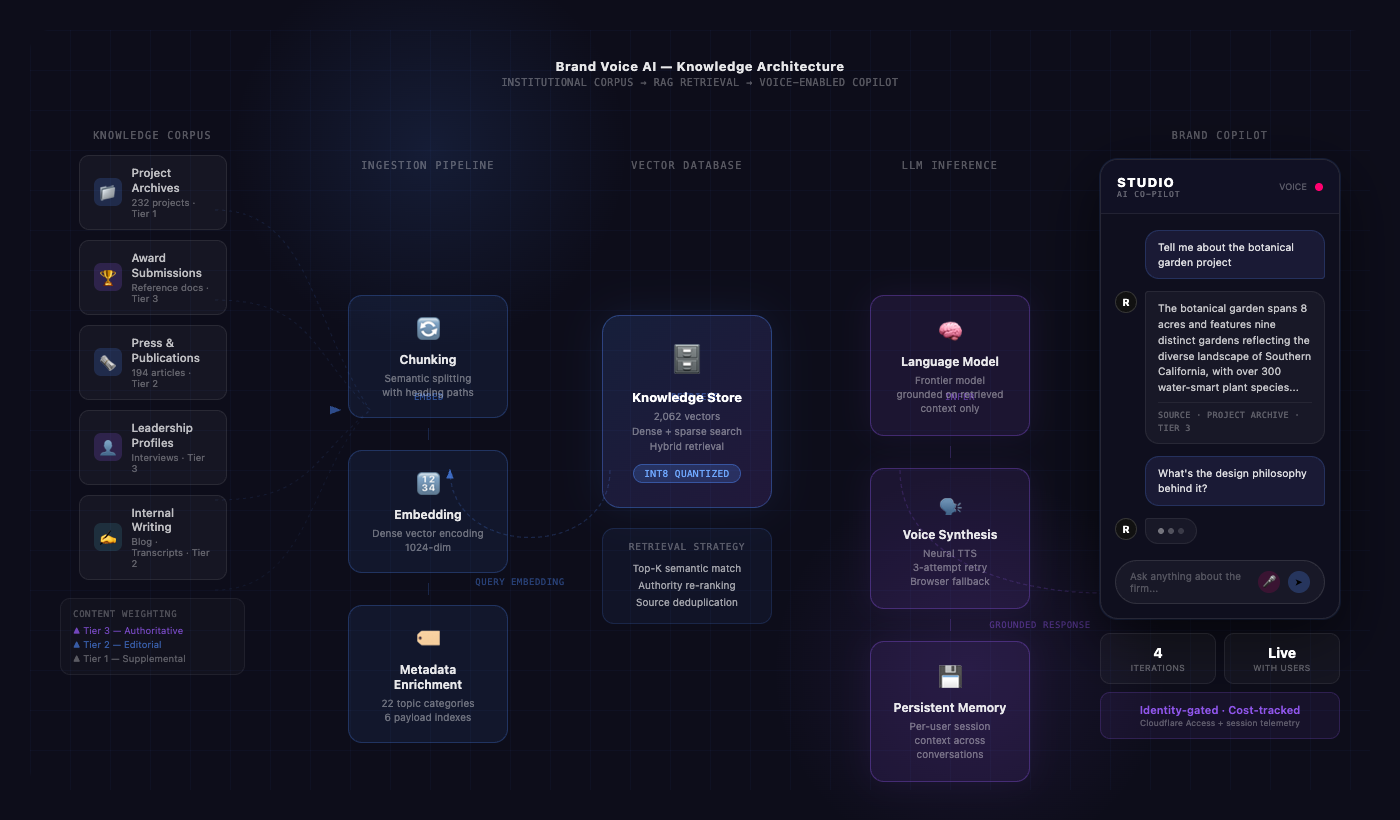
An AI knowledge platform that replaced the chain of emails:
- A voice-enabled assistant that holds natural, multi-turn conversations grounded in the firm’s own body of work. Staff ask a question and get a sourced answer in seconds, not time zones.
- A retrieval layer that unifies decades of institutional knowledge across more than a dozen source types, weighted by authority so award submissions and leadership writing outrank scraped external coverage
- Persistent per-user memory so the assistant picks up where the conversation left off, across sessions
- A parallel text-only variant for internal employee onboarding and testing. Same brain, no voice.
- Cost and usage telemetry per session so leadership can see what questions come up most, what it costs to answer them, and where the knowledge gaps are
- Four production iterations, each one moving closer to the firm’s native voice as the corpus matured
- Automated scrapers that continuously pull external coverage, press, awards, publications, so the knowledge base reflects what the world is saying about the firm in real time
- A pipeline connected to internal systems so new collateral, project documents, and brand material are ingested automatically as they are created. The corpus grows without anyone managing it.
What I learned
The model picked itself. Content tiering was the real decision. A flat RAG index on any frontier model produces plausible but generic answers. Weighting authoritative sources above scraped external coverage moves the output from “sounds like the internet” to “sounds like an internal strategist.” The client could not articulate what they wanted. The corpus, properly tiered, said it for them.